

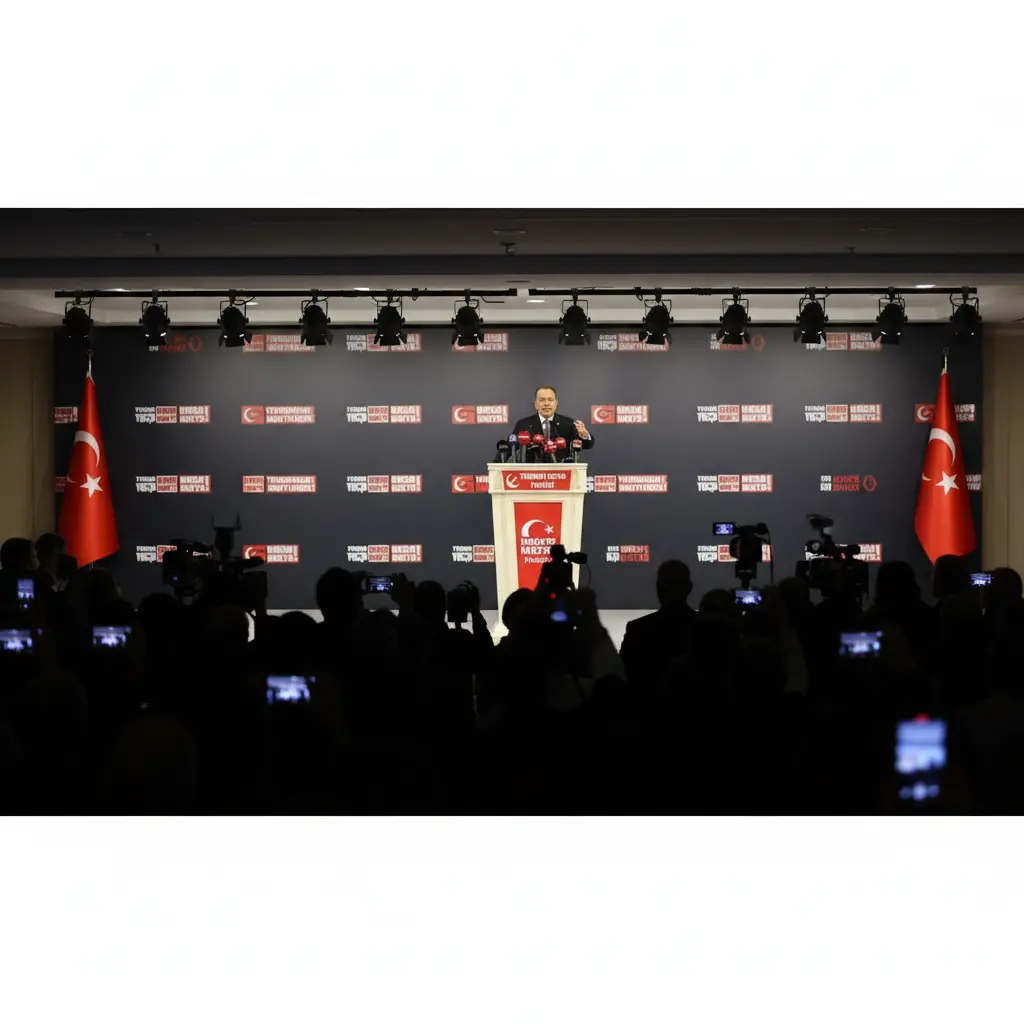
ANKARA, (DHA) – Fatih Erbakan, the leader of the Yeniden Refah Party, declared that the minimum wage in Turkey should be at least 45,000 lira. He made this statement during a press conference held before his party’s Provincial Chairmen Meeting at the National Youth Association.
Economic Challenges and the Need for a New Approach
Erbakan highlighted that alongside moral and spiritual erosion, economic difficulties continue to dominate Turkey’s agenda. He emphasized the necessity for Turkey to adopt the ‘National View’s’ economic development initiatives, advocating for justice in distribution. “Turkey needs to shift from an economy based on debt, interest, price hikes, and taxes to one focused on production, employment, and exports,” Erbakan stated.
Minimum Wage Proposal: 45,000 Lira with State Support
Responding to journalists’ questions regarding the minimum wage, Erbakan stressed the importance of reflecting economic growth in the minimum wage and raising it to the poverty line for a two-person household. “For this reason, we assert that the minimum wage should be at least 45,000 lira,” he said.
Erbakan explained how such an increase could be financed: “If the government allocates a portion of the money it spends on interest, and directs funds from wasteful spending and privileges towards the minimum wage, the state could easily cover the entire increase. It could even be structured as ‘one salary from the employer, one salary from the state,’ thereby preventing employers from facing undue hardship.”
Erbakan’s Referendum Suggestion on PKK Amnesty
Discussing his views on the ‘Terror-Free Turkey’ process, Erbakan reiterated his long-standing position: “From the very beginning of this process, we have always said that the laying down of arms must include the PYD and YPG, and that this process would not be fully complete with just the PKK’s disarmament. We observe that the ruling party shares these sentiments.”
He further added, “Another point we raised is that no steps should be taken that would upset or be disapproved of by the families of martyrs and veterans. We stated that it would not be appropriate for Öcalan to benefit from a ‘hope right’.”
Erbakan’s core proposal on this matter was for a national referendum: “Our suggestion is that any legal arrangements made in this regard should be put to a referendum. If our nation approves the pardoning of PKK leaders or PKK members who have not been involved in crimes, then they should be pardoned; if not, they should not. If we say, ‘Our nation wants this,’ and ‘We will carry out this process together with our nation,’ then such a referendum would be extremely appropriate.”